Welcome to the Holy Trinity Fell Walking Club in the village of Formby!
Get your boots on and join in the fun.
Walking on the Second Saturday March to November
Three Graded and Tested Walks - Coach Transport from Formby Village
Our next walking will be from a charming village right in the heart of the Lake District National Park in Cumbria, and was once the home of the famous poet William Wordsworth. Famous for Gingerbread and William Wordsworth, it has been a regular venue for the club because of its wonderful views, variety of walks shops and refreshment venues. It is
Grasmere
and will take place on
Saturday 8th October 2011
0800hrs prompt from short stay car park in the village
Helm Crag in Autumn
The village is on the river Rothay which flows into the lake Grasmere about 0.5 km to the south. The village is overlooked from the NW by the rocky hill of Helm Crag, popularly known as The Lion and the Lamb or the Old Lady at the Piano. These names are derived from the shape of rock formations on its summit, depending on which side you view it from.[2]
A number of popular walks begin near the centre of the village, including the ascent of Helm Crag and a longer route up to Fairfield. The village is also on the route of Alfred Wainwright's Coast to Coast Walk.[3]
Grasmere Village
The A591 connects Grasmere to the Vale of Keswick over Dunmail Raise to the north, and Ambleside to the south. In other directions, Grasmere is surrounded by high ground. To the west, a long ridge comes down from High Raise and contains the lesser heights of Blea RiggSilver How. To the east, Grasmere is bordered by the western ridge of the Fairfield horseshoe. and
We will leave the car park and make our way through the village of Grasmere.This ia your chance to assess the merits of the various watering holes for our return!Taking the Easedale Road - hoping it doesn’t lull you into a false sense of comfort - for a mile or so before we start the zig zag climb up onto Helm Crag.This is sometimes referred to as ‘The Lion and the Lamb” because of the rock structures.On a clear day you can see as far as Morecambe Bay.
We will continue along the ridge over Gibson’s Knott, Pike of Carrs to Calf Crag - Part of the ‘Coast to Coast walk’ - before dropping down off the ridge.
We will then climb up onto Greenup Edge, the ridge dropping down into Borrowdale.
We will then begin our descent into Far Easdale back into Grasmere.
This quiet valley, little changed from Wordsworth’s day, a pleasant end to a fairly energetic walk.
Our walk today involves a stiff climb to a great vantage point which is also one of Wainwrights peaks, a stroll uphill to another Wainwright peak, our highest point where we can look down upon lakelands biggest tarn and the start of our descent back down to Grasmere.
The Langdales from Silver How
The walk starts to the north of the village where we head uphill towards Allen Bank, once home of William Wordsworth, which we circumnavigate up a track. Already we are having great views of this beautiful valley and the massives surrounding it. As we come out above the trees the walking is easier and views better and it is probably time for our first rest before we cross Wray Gill and head for the gentle summit of Silver How.
Sleepy Grasmere from Silver How
After the photo shoots and the oooh's and aaah's we head westward across this broad ridge which starts at High Raise, the central peak of the lakes. Passing Youdell Tarn it is a bit boggy but a wonderful panorama as we pass the peak of Lang How then Swinescar. As we approach Little and Great Castle How the ground is more rocky and interesting, particularly for geologists. If we have made good time we will head for Blea Rigg which is a good lunch stop, looking over the Langdales and Crinkles [add 150ft climb].
Easdale Tarn near where we descend from just before Blea Rigg
After lunch we retrace our steps a bit to descend on an unclear pathway down to Easdale Tarn, a popular venue for many tourists following in the footsteps of Wordsworth. The ascent was popular during the Victorian period, and a refreshment hut was even established in the 19th century by Robert Hayton of Grasmere above the outlet of the tarn to service the thirsty visitors. The hut is long gone, and nettles now grow where the ruins used to be.
A group of visitors at Easdale Tarn
Our descent now is on a restored pathway all the way down back to Grasmere, but the delights are not over yet for we are alongside the rushing 'Sourmilk Gill' as it tumbles over a couple of waterfalls and we are now looking towards the Fairfield and Helvellyn ridges and memories perhaps of previous walks.
Sourmilk Gill in full flow
There will be many a cheerful greeting as we continue on our descent, enjoying the autumnal colours and the thought of refreshments at one of the many teashops and hostelries in Grasmere. Given the weather this is a lovely Fell Walk and even in bad weather we are protected and should be below the cloud line
On Blea Rigg Summit, a lovely lunch spot.
Thanks to Les Gibson who accompanied me on the reccie.
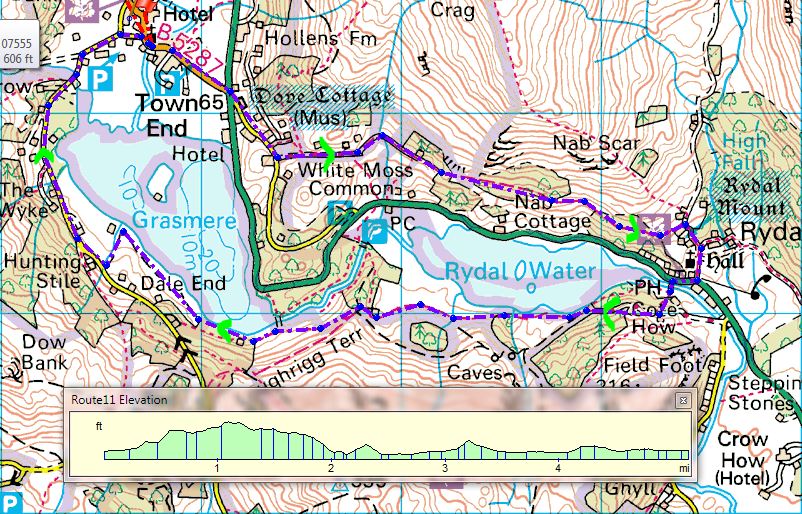
The walk leaves Grasmere in the direction of the A591. After crossing the main road the walk ascends to meet the ‘Coffin Trail’ and continues onwards to reach White Moss Common. High elevation views of Grasmere can be seen on this section. The walk continues along a bridleway to eventually approach Rydal Mount.
Rydal Mount
A slight descent towards the A591, to re-cross the road and access the narrow bridge opposite, before turning in the general direction of Grasmere.
The walk continues into a wood keeping Rydal Water just to the right, eventually ascending to reach a footpath which overlooks Rydal Water.
From this point the walk continues onwards through leafy woods to reach the lake side and then finally approach the town of Grasmere.
The Weir approaching Grasmere
The Weir
Grasmere water
A lovely cottage on the approach returning to Grasmere
Ground conditions are a mixture of footpaths, bridleways, woodland treks and minor roads. Views of interest are many and varied. There are no stiles to be negotiated but a few kissing gates and the walk is extremely pleasant.